EduVision-AI
Building accessible learning technology with visually impaired students and teachers.
My Role
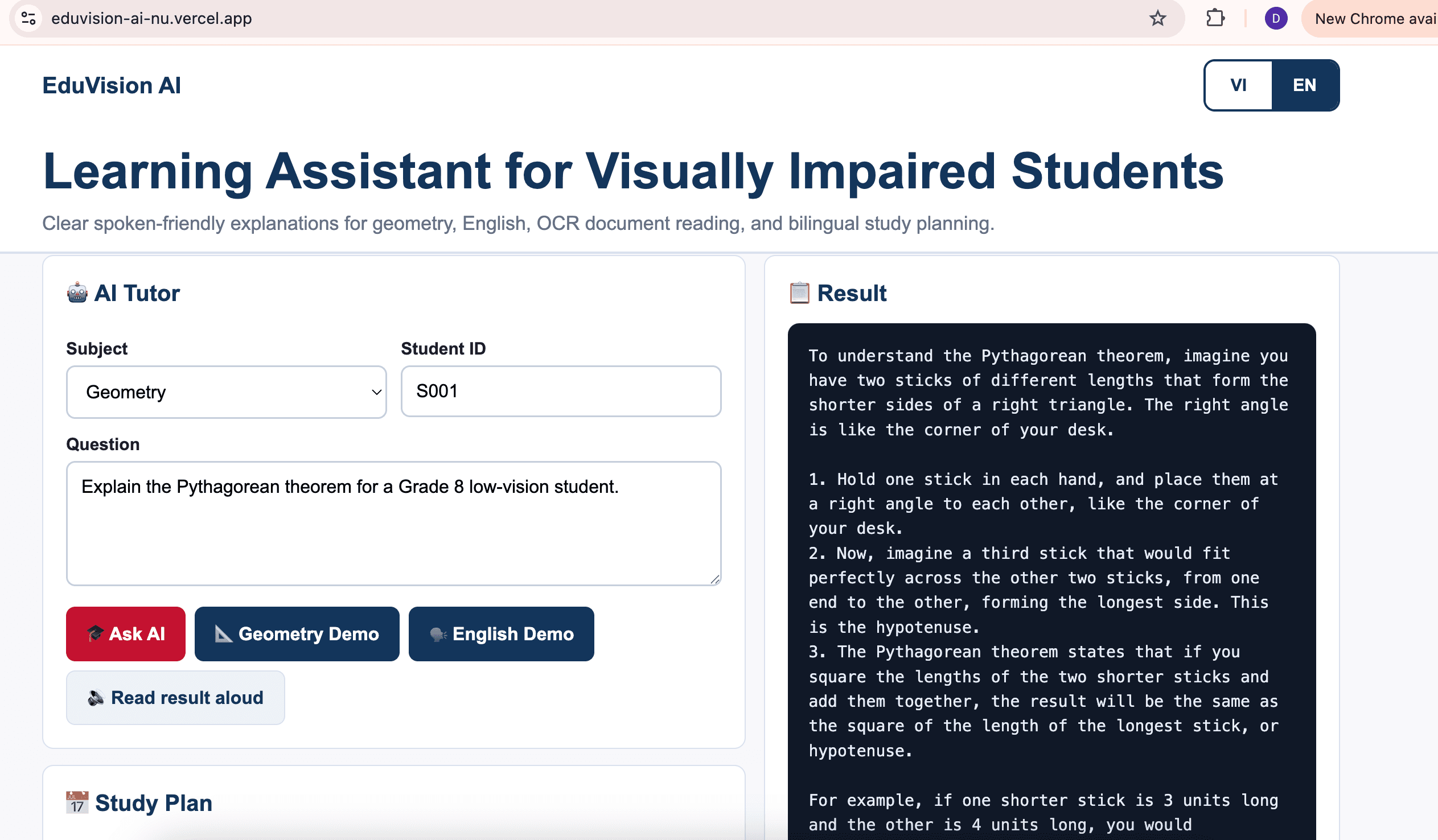
As founder and lead AI developer I framed the problem, ran the user research (30+ interviews), and built the full stack: a FastAPI backend with eight endpoints (AI tutor, OCR, TTS, study plans, profiles, progress), a RAG knowledge base so answers stay tied to the lesson, and bilingual Vietnamese–English text-to-speech — shipped on both the open web and a Telegram bot. Mina Thảo Dương co-led user research, content quality, and school partnership coordination.
Technology
Python · FastAPI · RAG · Google Vision + Tesseract OCR · Bilingual TTS (VI/EN) · Web Speech API (word-highlight sync) · Reading Ruler / WCAG AAA High-Contrast · Telegram + Web · JWT / data protection
Measurable Impact
- Visually-impaired students interviewed30+
- Accounts donated to NDC School200
- StatusLive + in use
- Presented atHwa Chong APYLS
The Encounter
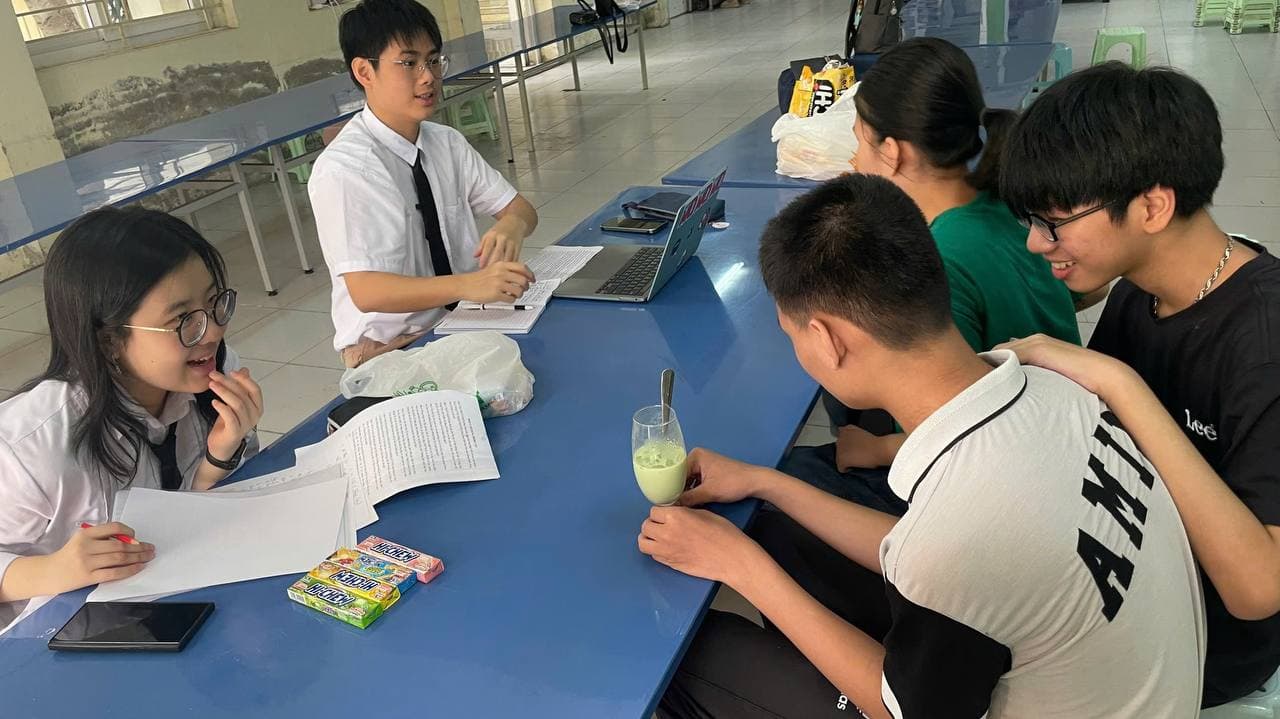
It started at the Nguyễn Đình Chiểu School in Hanoi, a school for students who are blind or have low vision. I went in expecting to help. I left realizing how much of the technology we call 'accessible' is still designed from a sighted person's assumptions — including mine.
What I Assumed
My first assumption was that the hard part was reading text aloud. Sitting with students changed my mind. The harder problems were navigation ('where am I on the page?'), diagrams that speech cannot describe, and the exhaustion of listening to a flat robotic voice for an hour.
What Users Taught Me
I stopped pitching my idea and started writing down theirs. Two findings reshaped the product: teachers, not just students, needed to prepare materials quickly; and audio needed structure — headings, chunks, and the ability to jump — not one long recording.
My Role
I led the project: framing the problem, running interviews, deciding the feature set, and building the first working prototype that turns a photographed page into structured, navigable audio. I coordinated a small student team for testing and content.
AI & Accessibility
A Python pipeline: OCR extracts text and layout; a language model cleans and segments it into headings and blocks and writes short factual descriptions for figures; text-to-speech renders navigable audio; speech recognition drives voice commands and audio flashcards. Structure over raw playback, and voice-first — because a touchscreen is not the natural interface here. The front-end implements WCAG AAA: word-level TTS highlight (each word lights up in sync with the audio), a Reading Ruler that follows the user's focus line, a high-contrast palette switch, subject-category tiles instead of dropdowns, and audio beep cues for loading and error states. Every setting persists across sessions.
Testing & Ethics
OCR on Vietnamese diacritics and messy scans is unreliable, so I added a review step for teachers rather than pretending the model is perfect. Describing a diagram risks inserting my own bias into a lesson — I kept descriptions factual and let teachers edit them. I only use student voices and stories with consent.
Measured Impact
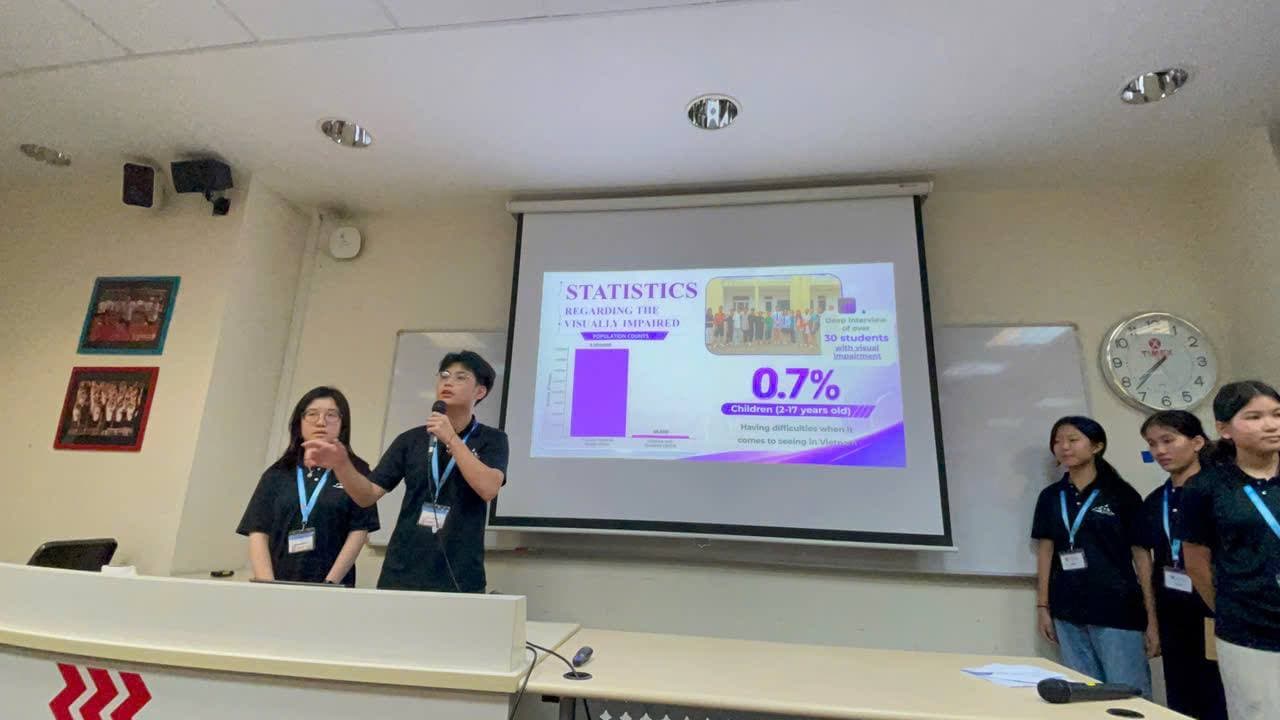
Before writing code I interviewed more than 30 students at the Nguyễn Đình Chiểu School for the Blind in Hanoi. The product now runs live at deepmath.vn, students at the Nguyễn Đình Chiểu School and several others have begun learning with it, and I presented it as a speaker at the Hwa Chong APYLS in Singapore — where the organizing committee issued a certificate. At Mid-Autumn Festival 2026, Mina Thảo Dương and I visited the school to donate 200 accounts directly to students and staff — closing the loop between the research visit and real access. I state only what I can show, and keep 'used', 'tested' and 'reached' distinct.
Evidence
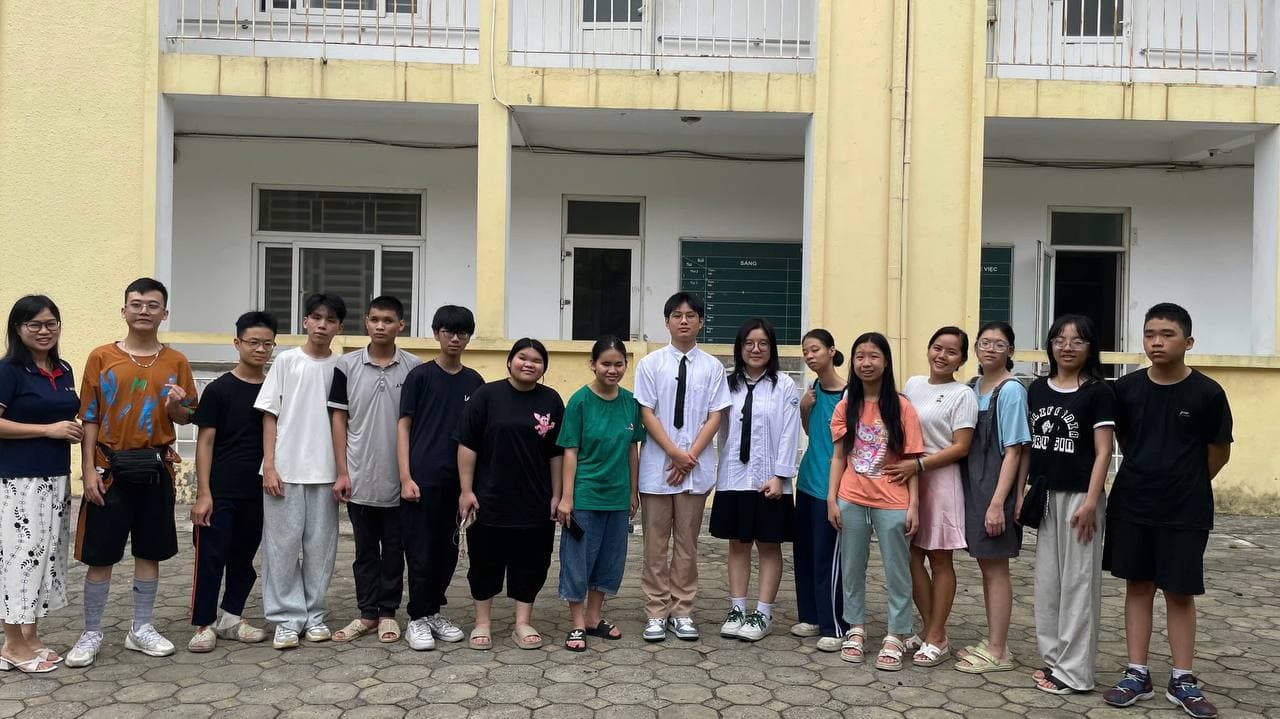
Code is open at github.com/NamDoji/eduvision-ai. The product runs live at deepmath.vn (demo also at eduvision-ai-nu.vercel.app). At Mid-Autumn Festival 2026, the team visited the Nguyễn Đình Chiểu School for the Blind and donated 200 accounts directly to students and teachers. Testing logs, teacher confirmations, and consented student feedback are being collected as verifiable evidence.
Technology
From the live product
Evidence
What I Learned
- Accessibility is not a feature you add at the end; it is the design.
- A solution is not truly intelligent if it excludes the people who need it most.
What comes next
- A teacher dashboard to prepare and correct materials in minutes.
- An offline mode for classrooms with limited internet, and a formal study of learning outcomes.
Last updated: 2026-09-18